Daniel Biss Wins in Illinois Despite Student Dating Scandal
· Reason
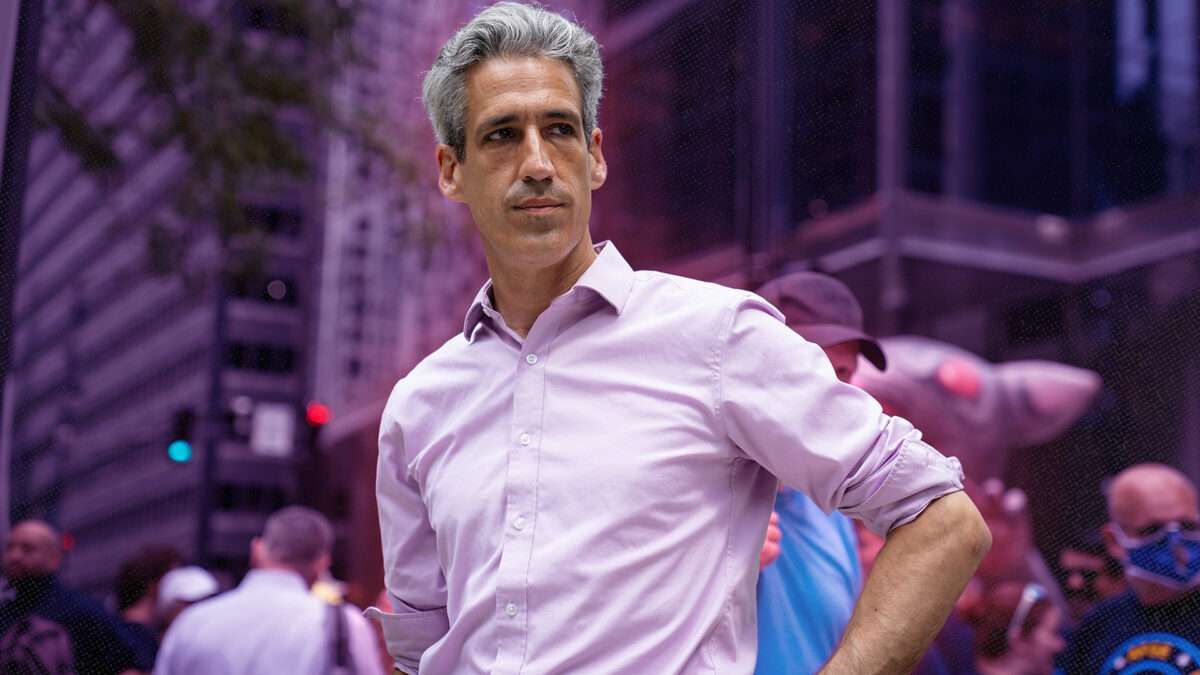
Illinois Democrats on Tuesday voted in favor of Evanston Mayor Daniel Biss being the party's nominee to replace outgoing U.S. Rep. Jan Schakowsky. His win came amid stiff competition—more than a dozen people were competing in the Democratic primary for the chance to represent Illinois' ninth district—and, perhaps, tells us something interesting about sexual politics along the way.
Visit likesport.biz for more information.
There are already ample signs that the #MeToo era is ending, and Biss' win may serve as another coda.
You see, Biss won despite a sex scandal—I use that term loosely; no sex per se seems to have occurred—involving an age gap and a power differential. Five or eight years ago, these may well have doomed the former state senator and college professor.
Of course, go back a bit further and Biss' behavior may have merely raised eyebrows. Go back just a few decades, and it would have been unremarkable.
Here's the allegation, in: As a math instructor at the University of Chicago, Biss had a brief relationship with an undergraduate student. The woman, Megan Wachspress, had been in one of his math classes, but Biss waited until the semester was over to ask her out. She was younger than him, but not by a lot—he was 26 and she was 20. And, after what Wachspress describes as "a few very intense evenings" that included "making out," Biss "had second thoughts" and decided "it was wrong to date a student."
So, both parties were adults, the age gap was relatively minimal, and Biss was not in a direct position of power over Wachspress when their relationship began. But by the logic of the #MeToo movement, all but the most minuscule age gaps are suspect and a professor should never, under any circumstances, ask a student out.
I strongly disagree about the age-gap bit. (I am, in fact, six and a half years older than my husband.) And, obviously, professors dating students in their classes should be off limits.
As for the appropriateness of dating between professors and students who are not in their classes, that's a tougher call. I know it used to happen all the time. But there still seems something untoward and off about it, to me. And that's especially true when the student is a major in the same department in which the professor teaches.
Even if a student isn't in the instructor's class at the time, they could wind up needing to take a class with that instructor in the future. They may want to rely on that professor for recommendations. And mightn't a student reasonably worry that saying no to a date could lead to the professor disparaging them to colleagues? Or to diminished opportunities in some other way?
I'm not going to say it should never happen. But a norm of frowning on it seems OK.
That being said, this business between Biss and Wachspress took place in 2004. Norms were at least somewhat different then (though it still would have been weird). I absolutely do not think any of this should be disqualifying for Biss now.
Wachspress—now a lecturer at Stanford Law—seems to feel differently. "If he's going to get a national profile on the strength of a younger woman's campaign, I'm going to come out and say it: during his short-lived tenure as a math professor, Biss had an inappropriate romantic relationship with one of his undergraduate students. I was that student," she posted to Bluesky on Monday.
Later that day, she went into more detail on Substack, suggesting that "this thing that had happened to me, that had been a huge part of why I gave up on a career" in math.
Far be it from me to question Wachspress' interpretation of her own life, but…I don't completely buy it. That a brief, consensual relationship with a young math professor stopped her from fulfilling her math dreams seems like the kind of thing one might tell oneself later as an explanation for a regret. And Wachspress did finish her undergraduate degree in math at the University of Chicago; she just decided to go to graduate school for something else.
Yet Wachspress' post is interesting, nonetheless. She reflects on why, as a professor herself, she's come to feel strongly that this was wrong, and points to a 2021 essay by Oxford professor Amia Srinivasan on the topic. "The question, I want to suggest, isn't whether genuine consent or real romantic love is possible between teachers and students. Rather, it is whether, when professors sleep with or date their students, real teaching is possible," writes Srinivasan.
Srinivasan goes on to offer an interesting glimpse of how feminist thought on this subject has changed:
U.S. universities began regulating student-teacher sex only in the 1980s. This shift was an outgrowth of the feminist campaign against sexual harassment that began in the 1970s [.…] Despite the bans' origins in feminist activism, some feminists at the time denounced these prohibitions as a betrayal of their principles. To deny that women students could consent to sex with their professors, they argued, was infantilizing and moralizing. Were women university students not adults? Were they not entitled to have sex with whom they pleased? Did such policies not play into the hands of the religious right, which was all too keen to control women's sex lives?
But in the past two decades, these arguments have been less prominent, and comprehensive bans on teacher-student relationships have had little pushback from feminists. This is in keeping with a deepening feminist anxiety as to whether true consent is possible when sex is marked by an imbalance of power.
For (at least some) feminists of another time, the idea that young women were unable to decide for themselves whether they wanted to be in a romantic or sexual relationship with a professor was an affront to women's agency. For (at least some) feminists of the #MeToo era, the idea that a professor-student relationship of any sort could ever be OK was not only wrong but also part of a continuum that included sexual abuse and rape.
I think the truth is probably somewhere in between. And that the Biss-Waschspress situation warrants an in-between response.
Let's not cancel Biss for briefly dating a student 20 years ago. But in our desire to defend him, let's not blithely assert that professors dating students is 100 percent fine.
And perhaps Biss' congressional run will show that's indeed where we're at as a culture in 2026.
Biss' win yesterday comes in a liberal, highly educated, and relatively affluent district, which includes the Far North Side of Chicago, its northwest suburbs, and the college town of Evanston, home to Northwestern University.
That Biss was able to win despite the Wachspress story might just be a function of the fact that the story hadn't had time to penetrate before the primary, since she had just shared it the day before.
As it stands, Biss "is favored to win the general election in November against the Republican nominee," per The New York Times. Whether the Wachspress story ends up coming back to bite him in the general election will be the true cultural barometer.
On SubstackCan you be a pronatalist without backing womb transplants? That's the question at the heart of this recent Emma Gilland post. "Some conservatives seem to be stuck between demanding women have more children while expressing disgust at new medical breakthroughs that would allow more women to do just that," she writes. More:
Read This ThreadThe birth of Hugo Powell, the first baby in the UK to be born via a donated womb transplant, has been criticised by conservative feminists, seeing it not as progress but further evidence that motherhood is being undermined by science. Grace Bell (with Steve Powell) was the first woman in the UK to give birth to a baby born from a womb transplanted from an organ donor, a woman who had recently passed away and donated her reproductive organs. Grace was born without a womb, as a result of Absolute Uterine/Womb Factor Infertility, and is one of 15,000 women in the UK with a similar condition.
This surgery was a huge step forward in reproductive technology, as alongside rounds of IVF, it allowed Grace to carry her own child, despite the fact she was told at 16 that she would never be able to do so. But it was heavily criticised by conservative feminists who are digging their heels into the sanctity of undisrupted, natural motherhood rather than embracing the fact that women, like Grace, are driven so strongly by the desire to become a mother, that they are willing to undertake complex and risky surgeries to overcome unimaginable medical challenges.
More Sex & Tech News???????? @FoxNews: 1 BILLION identity records exposed in ID verification data leak — INCLUDING +203 MILLION America records
Governments requiring Digital ID w/ "age verification" mandates create MASSIVE security risks
The threat is NOT hypothetical. Another unfortunate example: pic.twitter.com/eNYpBOcBvA
— NetChoice (@NetChoice) March 17, 2026
• "The White House and the House GOP have been quietly preparing to block state AI laws as part of a package that includes children's online safety legislation," reports Benjamin Guggenheim at The Washington Post.
• "Minnesota legislators are considering a troubling amendment to their state constitution," warns Kevin T. Frazier of the Cato Institute. "In short, the amendment would carve AI out of the state's protection of free speech."
• A new Proton program called Born Private "allows families to reserve a private, encrypted email address for their child for up to 15 years for just $1."
• "Today's AI-generated prose is riddled with flaws," bad metaphors, and "a cloyingly sycophantic tone," writes Jasmine Sun at The Atlantic. She talked to AI experts to figure out why.
• An update on Anthropic's case against the U.S. government:
So we have the first response from the government in the Anthropic case. The DoJ argues on behalf of the DoW & others that the red lines make Anthropic a national security risk. https://t.co/yAXn230cJJ
Some thoughts below 1/7
— Jennifer Huddleston (@jrhuddles) March 18, 2026
The post Daniel Biss Wins in Illinois Despite Student Dating Scandal appeared first on Reason.com.